

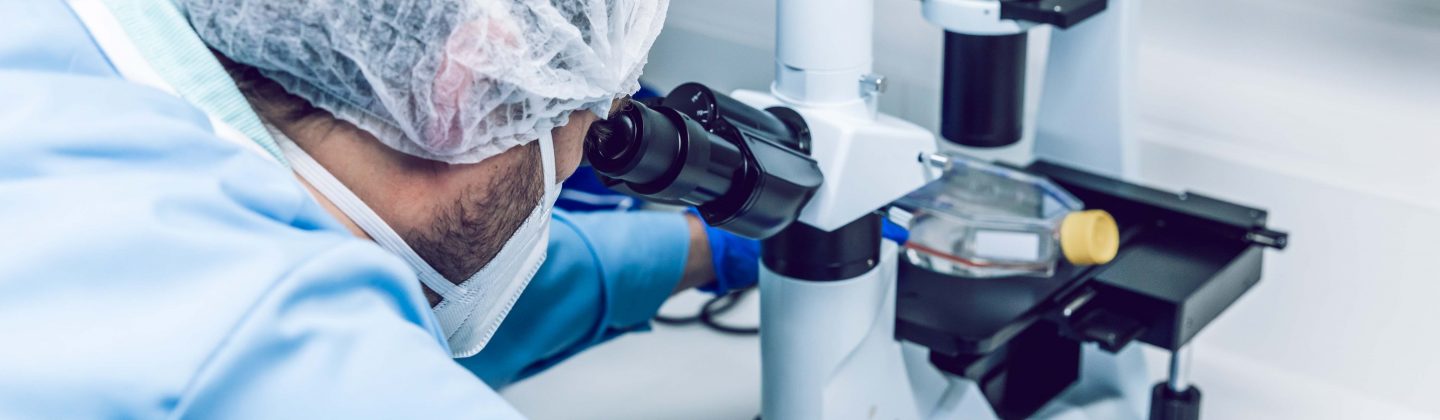
Biotrial is strengthening its molecular biology department to support innovative functional genomics programs. Leveraging expertise in CRISPR-Cas9 editing and base-editing technologies, Biotrial provides its sponsors with the ability to selectively silence genes of interest and evaluate their contribution to tumour development through rigorous in vitro and in vivo assays.
Our ambition: accelerate the discovery of novel therapeutic targets and contribute to the next generation of specific oncology treatments.

The story of CRISPR began in the late 1980s, when Japanese researcher Yoshizumi Ishino (Kinki University, Osaka) described unusually regular DNA sequences in the bacterial genome. These sequences would later be named “CRISPR” — Clustered Regularly Interspaced Short Palindromic Repeats. Over the following decades, scientists gradually uncovered their biological significance. In 2002, Francisco Mojica (University of Alicante, Spain) demonstrated that CRISPR sequences are widespread in prokaryotes and systematically associated with Cas (CRISPR-associated) proteins.
A decisive breakthrough came in 2007, when Philippe Horvath and Rodolphe Barrangou (Danisco Institute, Denmark) identified Cas9 and elucidated its function: a nuclease capable of cleaving DNA at specific sites. They revealed that CRISPR-Cas9 acts as an adaptive immune system, enabling bacteria to defend themselves against viral infections. Following bacteriophage exposure, fragments of viral DNA are integrated into CRISPR arrays, transcribed into guide RNAs, and used to direct Cas9 to destroy matching viral sequences during subsequent infections.
In 2012, Emmanuelle Charpentier (Institute for Infection Biology, Berlin) and Jennifer Doudna (University of California, Berkeley, USA) demonstrated how this natural system could be programmed for targeted genome editing — a discovery that earned them the 2020 Nobel Prize in Chemistry. This innovation has since transformed biomedical research and opened the way to novel therapeutic options for genetic disorders such as sickle cell anemia and β-thalassemia, as well as emerging applications in oncology.
For nearly a decade, Biotrial’s preclinical department has worked with the Canine Genetics team at IGDR (Institute of Genetics and Development in Rennes) on the HOTDog project (Human Orthologous Tumours in Dogs ¹). The project focuses on cancer as a source of biological material for the development of a model relevant to human disease. Similar to humans, dogs develop spontaneous tumors with the same features as in humans.
Through RNA-Seq, we discovered similar gene fusions as those found in their human counterparts (as exemple:IGK-CCND3 in B-cell lymphoma, MPB-BRAF in glioma, and COL3A1-PDGFB in dermatofibrosarcoma protuberans-like). Although rare, the disease occurs more frequently in genetically predisposed breeds, facilitating sample collection and longitudinal follow-up.

Through extensive epidemiological, clinical, histological, and genomic analyses, the HOTDog collaboration has strengthened the understanding of cancer and demonstrated compelling parallels between human and canine tumors, positioning these models as valuable translational tools.
We have shown that genomic profiling of tumour cell lines revealed frequent copy number variations (CNVs) in several genes, identifying them as potential oncogene candidates1. To determine whether these genes effectively drive tumorigenesis, we are able to selectively disrupt their expression to evaluate the resulting biological effects.
This is where CRISPR technology becomes instrumental. Biotrial scientists use an advanced CRISPR 2.0 approach based on a catalytically inactive “dead Cas9” fused to a Cytosine Base Editor (CBE). This system performs precise C-to-T conversions in genomic DNA. By targeting CAA, CAG, or CGA codons located early in a gene sequence, the editor introduces stop codons that truncate the protein and abolish its function.
Through in vitro and in vivo assessments — including proliferation, migration, and invasion assays — Biotrial Preclinical Department uses this strategy, enabling the identification of genuine oncogenes or tumor-suppressor genes. Ultimately, these insights open the door to new therapeutic targets with high translational potential in human oncology.
1 Discovery of Human-Similar Gene Fusions in Canine Cancers. Cancer res. 2017. Ulvé R et al. DOI: 10.1158/0008-5472.CAN-16-2691
2 Canine Oral Melanoma Genomic and Transcriptomic Study Defines Two Molecular Subgroups with Different Therapeutical Targets. Cancer. 2022 Prouteau A et al. DOI: 10.3390/cancers14020276
